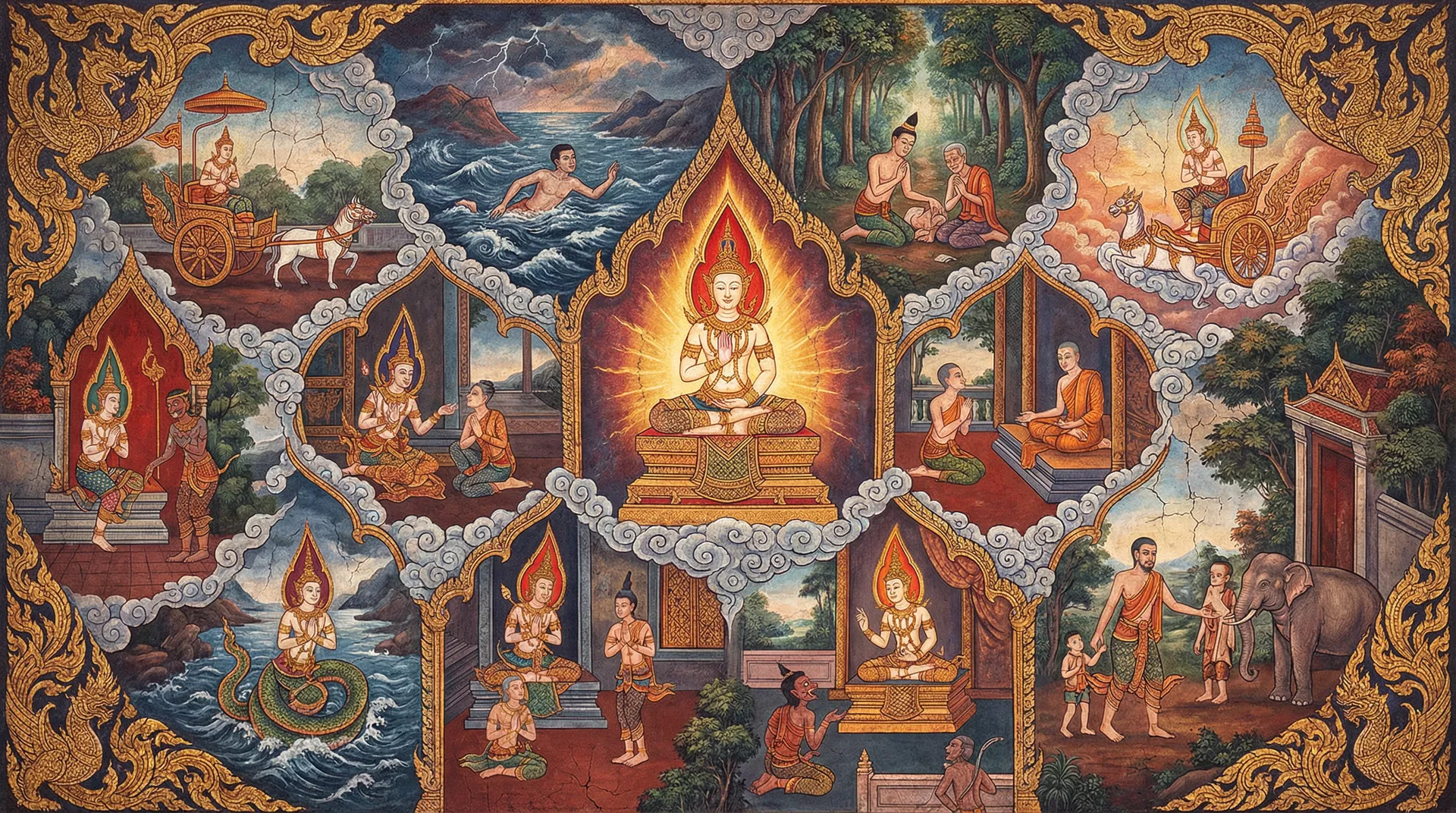
Sasa Jātaka
The Hare Who Sacrificed Himself
In a time long past, when the forests teemed with life and the stars shone brighter in the unpolluted skies, there lived a noble hare. He was not just any hare; his fur was the color of moonlight, his eyes sparkled like the morning dew, and his heart was filled with a boundless compassion. He lived with his community in a serene forest, sharing the bounty of nature and living in harmony with all beings.
One fateful day, a celestial being, the god Śakra, disguised himself as a hungry Brahmin and descended to the earth. He wandered through the forest, his guise of poverty and hunger meant to test the virtue of its inhabitants. His journey led him to the clearing where the hares resided.
Seeing the Brahmin, the hare, along with his companions, a monkey and an otter, felt a pang of sympathy. The Brahmin looked weary and famished, his voice weak as he pleaded for food. The monkey, quick and agile, offered the Brahmin some mangoes he had gathered. The otter, skilled in his aquatic domain, presented him with a fish he had caught from the nearby stream.
But when the Brahmin turned to the noble hare, the hare had nothing tangible to offer. He looked at the Brahmin, his heart aching with the desire to help. He knew that his own flesh and blood, his very being, could sustain life. His companions, the monkey and the otter, watched with concern as the hare seemed to ponder deeply.
Then, with a resolute spirit, the hare spoke. "Venerable Brahmin," he said, his voice steady despite the gravity of his decision, "I have no fruits or fish to offer. But I have my own body. If you are truly hungry, please, take my life and eat my flesh. It is the only offering I can make."
The Brahmin, his disguised form beginning to shimmer with divine light, was astonished by the hare's selfless resolve. The hare, without a moment's hesitation, went to a fire pit that had been prepared for cooking. He asked the Brahmin to ignite the fire. Then, he leaped into the flames, intending to offer his cooked body.
But as the hare touched the fire, the flames extinguished instantly. The god Śakra revealed his true form, his divine aura illuminating the forest. He knelt before the hare, his eyes filled with awe and reverence. "Noble hare," he proclaimed, his voice resonating with power, "your compassion is unparalleled. You have shown a generosity that transcends all understanding. You have proven that true virtue lies not in what one possesses, but in the willingness to sacrifice for others."
Śakra then gathered the ashes of the hare's burnt body. With his divine power, he placed them upon the moon, creating the image of a hare that would forever be visible in its luminous disc. This was his way of immortalizing the hare's ultimate act of selfless love and compassion.
From that day on, the image of the hare in the moon served as a constant reminder to all beings of the profound virtue of self-sacrifice and boundless compassion. The story of the hare became a legend, whispered through the rustling leaves and carried on the winds, inspiring countless souls to look beyond their own needs and embrace the spirit of altruism.
— In-Article Ad —
💡Moral of the Story
Selfless compassion and the willingness to sacrifice for the well-being of others are the highest virtues.
Perfection: Generosity (Dana) and Compassion (Karuna)
— Ad Space (728x90) —
More Jataka Tales You May Enjoy
 384Chakkanipāta
Mahāpaduma Jātaka
Mahāpaduma Jātaka In the ancient and prosperous kingdom of Mithila, ruled King Janaka, a monarch who...
💡 Lust, deceit, and false accusations lead to immense suffering, while truth, justice, and forgiveness ultimately prevail.
 526Mahānipāta
Mūga-pakkhajātaka
The Tale of the Silent Swan In the ancient kingdom of Mithila, nestled amidst rolling hills and verd...
💡 True wisdom can be cultivated in silence, and the ability to observe and understand is a powerful weapon. Sometimes, the most profound insights come from those who listen more than they speak.
 502Pakiṇṇakanipāta
Sālakaṅkāṭa Jātaka
Sālakaṅkāṭa Jātaka In the bustling city of Varanasi, where the Ganges flowed majestically and mercha...
💡 True contentment and happiness are not found in the accumulation of material possessions, but in appreciating what one has and in liberating oneself from the chains of insatiable desire. Simplicity of life leads to richness of spirit.
 450Dasakanipāta
Mulasira Jataka
Mulasira Jataka In the ancient city of Indapatta, there lived a king named Mulapariya. He was a bene...
💡 Uncontrolled anger and baseless suspicion are destructive forces that blind us to the truth and lead to injustice. Cultivating patience, seeking understanding, and maintaining a calm mind are essential for wise judgment and harmonious relationships.
 424Aṭṭhakanipāta
Sarabhaṅga Jātaka
Sarabhaṅga JātakaIn the ancient land of Gandhāra, nestled amidst snow-capped mountains and whisperin...
💡 True peace is cultivated from within and achieved through understanding, compassion, and wisdom, not through violence or the imposition of power. Inner resilience is the greatest defense against external aggression.
454DasakanipātaKusa Jātaka
The Kusa Grass Jātaka (Kusa Jātaka) In the kingdom of Videha, there lived a king named Kusādhvaja, a...
💡 Unfounded jealousy and possessiveness can lead to grave injustice and bring ruin to oneself and others. True strength lies in trust, forgiveness, and the courage to admit one's mistakes.
— Multiplex Ad —